Showing posts with label humans. Show all posts

18 January 2017

Questions Concerning Humanity and Utility

Humans are an interesting lot. It seems at once like yesterday and like forever ago that I wrote my blog entry, “Humans Are Actually Terrifying.” It seemed a popular enough piece at the time, but I think it’s good to spark some dialogue about the human condition and our habits as we live our lives.
            A classmate of mine asked, regarding architecture, “At what point does development become meaningless?” This made me think of some other things I have thought about, other questions I have asked: At what point do we realize that not every single human needs to ‘make a living’ in order to be valued and loved? What is the true purpose of cancer and why are we so intent on and obsessed with curing it in all its forms? What further studies can we do that might tell us the reason cancers appear? Isn’t cancer simply the evolutionary process taking place? Why do we grieve those who die? Is death not merely a part of life that we should all accept? Should we not honor the dead for who they were in life, rather than bemoaning the fact that they no longer breathe our same air?
            We should celebrate the lives of those who have passed. Take, for example, the late, great, Alan Rickman. Or, perhaps, the wonderful Carrie Fisher. Yes, it is sad that they are gone because they were wonderful to see on screen. Has it crossed no one’s mind, though, that perhaps it was their time to go? It may seem premature to us, as we expected Carrie Fisher to finish the Star Wars movies and Alan Rickman to tell his great-grandchildren about Harry Potter, but since when has the world cared about what humans think should happen? Life happens on its own terms and we simply need to grab on, hold on tight, and figure it out as we plunge forward with the persistent march of time. I was particularly devastated with the passing of Robin Williams. He was like the cool uncle I knew and loved but had never actually met. I felt an intimate connection with him that I would like to mention before anyone tries to tell me I simply don’t understand because I was never a true fan. It felt as though a family member and a true friend had passed when Robin Williams took his own life and I cannot fathom why he did it. All I know is that he was found to have hung himself on the day I gave birth to my daughter. Coincidence? I don’t believe in coincidences. For a while, I mourned Robin Williams, but I realize now that the best thing for me to do is to continue his legacy by ensuring that my wonderful daughter knows all of his movies, so that she can see what a wonderful soul we had with us for some time. I want her to know Robin Williams as I knew him, to feel him as intimately as I felt him, even and especially when he discussed mental illness. Robin Williams can help teach my child compassion and wherewithal, even if there is no longer a chance of my meeting him in person. I hope we can all think of our favorite late celebrities in this way.
            What is cancer, really? I always imagine one of two things. The first is to imagine feeling lumps multiplying within my body at an exponential rate, so that each time I poke a particular part of my body, it feels like more and more little balls are forming within. The other is to imagine what cells look like as they multiply… and multiply, continuously. Why do cells become cancerous? What purpose could cancer serve that humans are blind to due to our “divine spiritual and intellectual development”? People like to share things on social media that condemn cancer for the suffering it induces in those who become sick with it. People like to do things like participate in Relay for Life and purchase items from the Susan G. Komen Foundation for Breast Cancer Awareness (a scam if I’ve ever seen one). “Cancer is horrible!” “Fuck cancer!” “Rest in Peace Grandpa, Grandma, Auntie Susie, and Uncle John, all cancer victims…” I do not seek to belittle the emotional implications behind the suffering endured by cancer patients. I do, however, seek to belittle the way in which we approach the topic. Why do we think it is so vital to save every single life that comes into this world? Why are we the only species on the planet that coddles the weak and unfit? Is it so that we can flash our Good Guy Badges in one another’s faces and claim we’re such excellent citizens because we have compassion? What is true compassion? At what point does compassion turn from strength to weakness?
            I believe death is a part of life. I believe that we need to accept the inevitability of bodily death and focus less on what happens afterwards and more on what happens beforehand. The religious are, in many cases, entirely too focused on what seems to be the end of the journey that is life. I believe wholeheartedly in living in the moment as much as possible. Of course, it is important to plan for the future. After all, we do have an average life span depending on demographic and geography, so that virtually every person on this planet could plan as if to live up to that point. In this way, people could be prepared for the future even if they weren’t to reach as far into it as they’ve planned. We also need to learn from the history we are taught and presented, as well as do our own historical research in order to develop well-rounded ideas of what has happened over time and what mistakes were made, so that we do not continue to repeat that which has been detrimental to our livelihoods. It has been said that the smart man learns from his mistakes while the wise man learns from the mistakes of others. I believe this is true and I strive to learn from the mistakes of others so that I can push forward and hopefully contribute to human evolution in a positive manner. This leads me to a connecting point…
            In coddling the weak and unfit and by supporting those who would otherwise die in nature’s survival of the fittest, do we waste resources on those who do not contribute to our futures? In what way are the severely handicapped useful to our lives aside from teaching us a level of compassion that is virtually useless? At what point will our habit of coddling the weak come back to bite us in the ass due to overextension of resources? We are already an overpopulated species on this planet and we continue to fuck up the environment by transporting wildlife from place to place, disturbing local ecosystems and forcing species after species into extinction not only from the transport of species to new lands but also from such abhorrent activities as shark finning and bottom trawling our oceans. We worry about sustainability but who will we be sustaining for? At what point will we need to prioritize human lives based on people’s merit? At what point do we stop demonizing eugenics due to the Holocaust of World War II and instead look at it as a viable possibility for improving the human race and reducing our impact on the planet?

            I encourage feedback to every blog entry, but this particular entry is one on which I very much wish to see dialogue sparked. I would especially like to see what some thoughts are as far as the question regarding architectural development, as that is the question posed that sparked this entry and all the questions I’ve presented herein.

09 April 2016

An Unpolished Account from Kirkland to Hoquiam

In my life, I have decided to make a point of not talking badly about people behind their backs. It was driven home yesterday that not everyone shares such a desire to avoid gossip and bullshit. I learned yesterday that someone who used to be a “friend” is jealous of me and likes to talk shit about everyone around her.
            The conversation started innocently enough. Randy, my friend Kelly, her dog, my dog, Persephone, and I all met with another friend of mine in Kirkland, a place I’d never visited before. I was pleasantly impressed by what I saw of Kirkland, little as it was, and my friend, Kara, and I were sitting on the grass, she with her son and I with my dog, as Randy chased Persephone around the grass. I’m not sure why or how the conversation ended up on a Facebook group we’re in, but Kara mentioned the group, which I’ll call the Lounge, and asked me a question having to do with some other group members.
            “Some of the other ladies left the group,” she said. I hadn’t known anything about it, so I hmm’d and ha’d and nodded my head, furrowing my brow and mentioning my ignorance of the other, now former, group members’ activities. At the mention of other members of the group, though, I thought of someone who had been a mutual friend to Kara and me who goes by Nessa. Opportunity bloomed before my eyes for me to tell someone about how Nessa had suddenly, unexpectedly, and without a word to me, deleted me from her Facebook friends’ list. I didn’t feel that it was a great loss—Nessa had blatantly avoided my Halloween party last year, only to have the gall to invite me to her house when I’d expressed that no one was showing up to my party—but I hadn’t had anyone to tell about her having deleted me until just now, because I didn’t have anyone nearby who would have cared to hear about it in any capacity.
            “Nessa deleted me from Facebook,” I said, adding something before the sentence to segue into the topic. The reaction from Kara wasn’t quite what I’d expected, as she said: “She’s jealous of you.” Did I say that wasn’t quite what I’d expected? Let me correct that: It came as a complete surprise. My eyes widened and I couldn’t believe what I was hearing.
            Well, it was then that I learned that Nessa had been talking badly about me to Kara, who did nothing to add to it and simply tried to diffuse the situation when it came up (after all, she and I are friends and I’ve done nothing to incur either woman’s wrath), but of course I was filled with a burning curiosity to know what was said about me, behind my back, without my knowledge. Happily for me, Kara was happy enough to oblige and humor my curiosity.
            What I learned wasn’t necessarily very specific, but it was quite revealing. Before delving into the things Nessa had said about me—which were quite unimportant but satisfied my curiosity nonetheless—Kara mentioned that Nessa had betrayed her, and not slightly.
            The story is not mine to tell, but suffice to say that what Nessa did was a complete betrayal of trust with Kara and, as far as I’m concerned, was unforgivable. Kara is a more forgiving woman than I, however, and she did forgive Nessa for it—though she admitted to me that she shouldn’t have, based on the caliber of person Nessa has proven to be. Long story short, the betrayal had to do with an actual legal case that was going on and Nessa gave out information that she had specifically been forewarned not to give out. Her excuse when she apologized profusely was as follows: “I didn’t mean to.”
            She didn’t mean to? I don’t think so. Let’s spell out a scenario of similarity in order to shed some light onto my incredulity. Let’s say that Susie is my partner’s ex and she’s trying to keep half of my partner’s belongings because they used to be together, but my partner wants his belongings back, so he’s fighting for them using the legal system. I don’t want Susie to know anything about me because it could somehow jeopardize my partner getting his things back, so I tell my friend, who has become friends with Susie, that I don’t want Susie to know about me. I specifically tell my friend, Nessa (let’s at least keep that part consistent), “Please don’t tell Susie anything about me. I don’t want her to know my name, where I live, what I do for a living, or anything. Nothing. Please.” Nessa agrees, but the next thing I know, Nessa has told Susie every last thing she knows about me!
            I would never have forgiven Nessa.
            Hearing Kara’s story was infuriating. I was filled with a kind of righteous rage, that which drives me to exact vengeance on those who have wronged me or those close to me. I put it aside, however, as it’s not my battle and my friend had already forgiven her for the betrayal, whether it deserved forgiving or not. So, rather than getting into a rage and ranting about the injustice of it all, I mentioned my Halloween party—which led to my learning that Kara had planned to attend, with Nessa! Another surprise!
            This was when I learned that Nessa enjoys making plans with Kara and being the person who coordinates it all, with or without Kara’s knowledge but often with her involvement, only to then decide to cancel and leave the cancelling up to Kara, who beforehand hadn’t even known she’d be involved. It’s a shitty thing to do. Imagine if you and I were friends and I made plans that involved you, but didn’t tell you about them. You get a call from the person with whom I’ve made the plans: “Hey, are you still coming to my picnic?” You’re surprised: “What picnic? Was I going to something? What’s this about?” Suddenly, you become aware that I’ve signed you up for an event without your consent or knowledge. Then, on the day of the event, I say, “You know, I just want to stay home. Can you cancel? Also, can you find a bus back to your house since you don’t have a car and I don’t feel like driving even though I don’t have an issue with gas money because you’d help me with it if I would just give you a ride?” Essentially, that is what Nessa does to Kara.
            When Kara said she’d planned on coming to my party with Nessa, I was angry with the latter woman all over again. How dare she ignore my party completely, make plans with someone to actually attend, then cancel and follow up with the gall to invite me to her disgustingly filthy household to do what I could only assume would amount to sitting outside and smoking weed, because the interior of the house is revolting and also a health hazard…which brings me to my next point.
            Nessa was offended when I looked out for the health and well-being of a child at her home.
            Nessa is not a mother. She cannot understand motherly instinct and she clearly doesn’t respect one mother’s concern over another mother’s child. Nessa had requested help in cleaning her disgustingly filthy home, and I had volunteered because it had been my idea that she should conduct a cleaning party and get as much support as she could, so as to get it done and maybe make it fun. Another friend of mine helped, admittedly more than I did, but on the first day, I was there. So was another woman Nessa had invited.
            The other woman had a small child, perhaps 4 or 5 years old, if memory serves. The house was full of fumes from unchanged kitty litter and stagnant chicken shit in the floors. Unhealthy, respiratory-problem-causing fumes. So, looking out for the child, I suggested keeping her outside so as to prevent her getting sick. Kara told me that her son gets sick every time she takes him with her to visit Nessa’s home. Yet, Nessa took great offense to my concern, choosing to take it as some kind of slight against her. Ridiculous.
            It turns out, from the enlightenment I received from Kara, that Nessa seemed to decide she no longer liked me after I suggested keeping the child outside for health and safety reasons. I had no idea. Nessa never said how she felt while I was at her home, cleaning without safety equipment, nor did she send me a message over Facebook or a text message via phone to express her feelings over the matter. She did, however, feel comfortable with venting all about it to Kara, which turned out well for me because I get a much better idea of her character in addition to getting closure over the issue.
            I will have it known that I did not consider the loss of Nessa’s Facebook friendship to be a big loss. I looked at the “add friend” button on Nessa’s page and thought, “Well, that was unexpected.” That was about the end of it for me, until my good friend, Kara, enlightened me further.
            If anything, my conversation with Kara about Nessa made me feel better about myself and gave me closure to an issue that had vaguely confused me. Someone is jealous of me. What an ego boost! The only other person who has admitted to being jealous of me has done so to my face and it was my older brother, who has proven himself to be a real nigga capable of real talk, whereas this bitch can’t even tell me to my face how she feels. My older brother thinks I’m better than him—it’s not true, but it’s what he told me he thinks, to my face, because he has balls—while this bitch complains about me behind my back and talks about how “negative” I am when I post a meme.
            I compare Nessa to my older brother only because they’re both jealous of me. That is the only connection and the only reason I think about it is because, for the longest time, I thought my brother was a bitch-ass nigga. Ebonics may not be my first language, but I’ve become familiar with it and it is the most appropriate way to describe some things. This is one of those things. Hearing about Nessa made me realize that my brother isn’t nearly as lame as I thought he was and he does, in fact, have the intestinal fortitude to be a good man. I have so much more respect for him now than I did before the revelations of Kara.
            So, for my brother, Cristopher: If you’re reading this, I love you and you are important to me. I want to help you in any way I can to make your dreams come true.

11 September 2014

The Happiest Baby

                I’d have titled this entry, “The Happiest Baby on the Block,” but that’s probably a registered trademark, as it’s a DVD of tips and tricks to calm a fussy baby. I gave birth to my daughter, Persephone Anne, on August 11th—about a month ago, now—and from the very start she has been an absolutely wonderful baby. She doesn’t fuss much, and when she does, she’s very easy to soothe. This entry is the story of having the baby and how I’m doing a month later with her.
                I was worried from the moment I found out I was pregnant and it was too late to terminate that I would end up with postpartum depression after birth. Deep down inside, I knew with a morbid certainty that the mental illness would rear its ugly, tar-black face and there would be no avoiding it. What I didn’t know was how soon it would show up. After all, baby blues are normal and postpartum depression usually kicks in a little later, right? That’s what I’d heard and gathered from all the research I’d done prior to having my baby.
                The afternoon I broke my ankle, I went to the hospital and was in the ER for many hours before moving up to the Labor & Delivery Triage to be monitored. Ultimately, the hospital staff decided to induce my labor and it was decided that I would have my baby. I mentioned this in my last entry, which detailed how I broke my ankle. I was given an epidural and labor didn’t last too long, really. I’d say it didn’t last more than twelve hours, but I don’t think that’s quite accurate, so I’ll say it didn’t last longer than six hours after the nurse broke my water. I didn’t feel it until the baby started moving out—and then she was pressing hard against my right hip and it felt like the hip would split open!
                It was a smooth delivery. My baby was, and still is, completely beautiful and I received a few stitches to aid recovery from a small tear the baby caused. We were later moved, a few hours later, to a different room, where we were to stay for about 48 hours while they monitored the baby and me. Everything was going well…until maybe 24 hours later.

                From the moment I started actively pushing the baby out of my body (a little before that, actually), up to the next night, I got no sleep at all. I might have napped a couple of hours, but it was certainly nothing significant. On top of that, I was beginning to have difficulties breastfeeding. Persephone, my new daughter, wouldn’t take enough of my nipple into her mouth for a proper latch, which left both of my nipples blistered and feeling pinched. Come Tuesday night, I couldn’t latch her on for the pain and I couldn’t manage to make the nipple guard stay on a nipple for her to eat that way.
                With my broken and sprained ankles inhibiting my movement, the pain from childbirth, and the pain in my nipples all piled on top of a baby screaming from hunger, I couldn’t handle it anymore and I was sobbing along with my newborn. Words came out of my mouth and I don’t remember all of them, but among them were things like, “I’m sorry, but you’re hurting me!” and “Why are you crying?!” Looking back, the second quote looks completely wrong; I knew exactly why she was crying and I was feeling completely inadequate and useless with the pain in my nipples rendering feeding her impossible.
                Multiple nurses came in during this episode and tried talking to me. Randy took the baby to another room and a nurse tried talking to me—continuously saying my name wrong, pronouncing it like uh-leash-uh instead of the correct uh-leash-ee-uh. I couldn’t handle it the third time she said it and I yelled at her, “It’s Aleashia!” She promptly got up and walked out of the room. I was later given a breast pump to express enough milk for Randy to feed the baby while I got some sleep; then, I was provided some Benadryl to assist with the actual sleeping.
                When I woke up, I didn’t feel much better, but I’d gotten a few hours of sleep. I immediately wondered where my baby was and pressed the nurse call button to ask. A few minutes later, Randy came in with her and said that all was well. I was still relatively miserable, but it was good to know the baby was doing well.
                It wasn’t long after that—the next day, maybe—that I was getting everything situated to feed Persephone. I moved to get my blanket out of the way so that I could position her properly to feed when all of a sudden she flipped over and off the bed—landing on the floor. It was so sudden, I immediately had Randy call the nurses in. The baby hadn’t landed on her head; she’d landed on her side, maybe her shoulder, but I was worried that she might have hit her head.
                The next thing I knew, we were still in the hospital long after we should have gone home and when we asked what was going on, we found out that the pediatrician had called Child Protective Services.
                Ultimately—long story short—CPS closed our case the day we went in to talk to them. The baby is safe.
                Now, for the best part of this entry: The fact that I have the happiest baby I’ve ever known. Persephone isn’t particularly fussy, but when she fusses, it’s usually really easy to find the problem and fix it. Most of the time, she wants my nipple; popping one in her mouth will calm her down immediately. Every parent knows the checklist: Is the baby hungry? Does the baby need a diaper change? Is the baby hot or cold? Is the baby bored? Does the baby just need to cry for a while? Does the baby need to burp? There’s more to it, though. If you go through the entire checklist and the baby is neither hot nor cold, nor bored, nor hungry, nor dirty, nor gassy, and the baby continues to cry, there are ways to easily calm the baby.
                In the film, The Happiest Baby on the Block, the man I will call the Baby Whisperer has what he calls the five S’s: Swaddle, Side/Stomach, Swing, Shushing, and Sucking. When Persephone continues crying for no reason, I swaddle her. It almost never works by itself, so I put her on her side and begin swinging her. Usually, this is enough to calm her down; other times, I have to shush her on top of it. Other times, I have to pop a pacifier in her mouth on top of it all and simply work with her for a few minutes, but ultimately, the five S’s work wonders. I have an extremely happy baby, ultimately, even though these past couple of days have been a bit more difficult than usual.
                I love my daughter so much more than I thought possible.

25 August 2014

Broken!

                Just about everyone I know has, at some point or another, broken a bone. I’ve been relatively proud of the fact that I had never broken a bone, something that seemed a bit funny to me after an incident in 2007 where I broke some cartilage off in my knee. Well, my winning streak in which no bones in my body had been broken during my life had to come to an end sometime, as determined by the Universe, and the Universe decided that Sunday, August 10th, at nine months pregnant, I was to break my ankle.
                The morning started out fine. My dad and littlest brother came out to visit and the plan was to go to Northwest Trek—my grandparents, dad, and brother. My grandpa was almost determined to keep me at home so that I wouldn’t go into labor while walking the pathways or riding the tram, but I went along while Randy slept (he did not want to get up).
                The tram ride was the first thing we did, which was fantastic, because it meant that I could go into labor any time during the day afterwards and it wouldn’t really matter. We walked the park, though, and I felt no labor pains—no contractions, nothing. I was a bit disappointed; the main reason I’d wanted to go to the park, aside from a strong desire to get out of the house for a while, was so that I could walk around a lot and hopefully move things along to get the fetus out. We came home without incident and I went to the bathroom, which was when I heard Mema (my grandma) rushing through the house and saying something about Liliana, my cat, getting out through the window screen on the back porch.
                Quite concerned, I finished my business and headed outside, wanting to help find the cat, which was likely long gone by this point. But I hated feeling useless—being nine months pregnant renders a woman relatively useless in a lot of ways. I headed down the porch steps and on the last step, rolled my right ankle. My left ankle followed as I tried to catch myself, and I heard a pop and felt a snap in my ankle as I fell flat on my butt—screaming. My dad and grandma came running and out came my grandpa, everybody trying to get me to calm down, which simply wasn’t going to happen right then. I knew my ankle was broken, but then Mema said something about the possibility of only having pulled a tendon. Somehow, with much help, I scooted back up the porch steps using my now-sprained right ankle.
                I sat for a while as Beba—my grandpa—wrapped my left ankle in a bandage. I repeated a few times that I needed to go to the hospital, and finally I was helped out to the car by my dad and Beba. The ride to the hospital was excruciating, every bump in the road jarring my broken ankle despite its being wrapped. Finally, we arrived at the emergency room and a wheelchair was brought out for me. With some help, I managed to get into it and I was wheeled inside, where they stuck me on the bed in a room for trauma patients.
                This all started around 2 in the afternoon, which was roughly the time of the fall. I was sitting around in the emergency room for hours, going from the trauma center to radiology and back again as they took X-rays of my ankles and spine while using multiple shields to protect the fetus. The next thing I knew, it was extremely late—like, 10pm late—and the orthopedics had finally shown up to splint my ankle, which had been determined to be broken. Nobody said anything about my right ankle except that it was swollen—as if I couldn’t see that for myself. After getting the angle of my foot wrong in the first splint—and causing me to scream-cry uncontrollably like a newborn (literally)—the orthopedics finally got a splint on correctly, but not without other doctors coming in and giving me pain meds through my IV despite my protests that they were ineffective and I didn’t want my baby being all drugged up.
                At last, the splint was finished. They left my right foot and ankle completely alone, though, which was rather annoying, considering how swollen it was.

                Why, yes, my right ankle was swollen, thanks for pointing that out… and leaving me to know that it’s sprained without a professional determination. That swelling got worse over the course of the next week and a half, swelling so that my toes no longer resembled my toes and instead looked like tiny, fat sausages at the end of a really fat… something. I’m really not sure what I would call what my foot looked like at its most swollen.
                I was stuck in the hospital for the week. After having my left ankle put in the splint shown above, Randy wheeled me upstairs to the labor and delivery triage of the hospital, where they monitored me for several hours, beginning around midnight when I arrived. I had Randy take Mema home at that time, since I didn’t know how long they would keep me there. Around 3am, the doctor came in and began telling me how and why he believed that they should induce my labor to have my baby. I was surprised and felt a bit of victory—when I had arrived in the triage, I’d mentioned having the baby to the first nurse who came in and she told me why they prefer not to induce labor until after a mother had gone the full 40 weeks of pregnancy. This turn of events, I thought, was rather convenient; I wouldn’t need to return to the hospital later to have the baby.
                I was induced Monday and had the baby that afternoon… I had an appointment back with orthopedics on Friday and as it turned out, I ended up having to stay in the hospital for the week, so when the time came, I was wheeled down to orthopedics, where I received an actual cast.
                I’m supposed to be non-weight-bearing on this ankle for 6 weeks. It’s been two weeks now and it feels like eternity, since this is the same leg in which I broke part of the cartilage off in my knee and I’d had to go 6 weeks non-weight-bearing then, too. I’m sick of my right leg getting so much exercise over my left!

24 June 2014

Humans are Actually Terrifying

                Many blog entries have been made to illustrate the scariness of nature. Usually, these entries revolve around animals and how terrifying they can be—and many of them have similar themes. You’re afraid of spiders? Here’s a list of the 10 largest/deadliest/scariest-looking spiders we can find pictures of and information for. You like cats? Here’s a list of the most unsettling facts we can possibly find about the feline world. Wait, you think these particular animals are scary? Let me tell you all about the animals that eat them.
                Other blogs have gone the other direction—posting information in order to convince us that nature isn’t scary at all and the world is really a wonderful place full of beauty and mysticism. Such articles include things like the top 10 largest holes in the ground, largest lakes, most strikingly-colored aquatic life, etc.
                A news article covers the “ten scariest animals in nature,” an article that seems to debunk the scariness of some animals while illustrating that others are scarier than we thought.
                Popular images when one Google searches “scary nature” include deep-sea life and tremendous storms, along with the occasional image of nature eating something like a street sign.

                Still other blogs like to simply post information with no hidden agenda. The best example of that, in my opinion, is a video series by zefrank1 on YouTube called “True Facts About...” The videos themselves are highly amusing and great fun to watch, yet they still cover facts that are, in fact, true (imagine that!).
                However, how often have we taken the time to look at humans as a creation of nature? Religious people like to argue that we are created by an almighty, omnipresent, omniscient, benevolent, just, jealous, vengeful, mysterious “God”, when the truth is that nature “created” us, just as it created every other mammal, reptile, amphibian, sea creature, and plant on the planet. The truth is that evolution is a fact, whether you decide to believe in it or not. The greater truth, as I have come to know, is that humans are by far the scariest creatures ever to come from nature.
                “But what about the box jellyfish?!” one might ask. The box jellyfish minds its own damn business and won’t hurt you unless you mess with it—intentionally or not. Now, let’s focus on what I’m actually saying, please.
                Humans are the only creatures to unintentionally cause serious harm to the environment. Wikipedia hosts a lovely list of nuclear and radiation accidents and incidents (actually the name of the page, if you want to look it up yourself), organized so that you can jump to one category in particular if you’re so inclined. Their list of nuclear meltdowns is one that I find particularly compelling for illustrating my point.
Images of Nuclear Accidents:


                Those are accidents. Those images and the lists on Wikipedia don’t address what humans do deliberately to destroy the planet. A lot of people think explosions are cool. The Myth Busters are famous for blowing stuff up in nearly every one of their episodes. I have a number of friends who think explosions are really cool-looking; these are also friends who advocate firearms and are great fans of what Americans like to call “air power”. Now, don’t get me wrong, explosions can look cool… but…
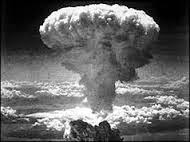
                I’m sure we’re all aware of the attacks on Nagasaki and Hiroshima. Here’s a look at those explosions.
Nagasaki and Hiroshima

                Those are pretty nifty, aren’t they? Nuclear explosions are famous (or infamous) for their mushroom-shaped clouds and, conveniently, Google has a nice collection of images in stock! But this post isn’t about the explosions. It isn’t about weapons or war or firepower of any kind. This post, I’ll remind you, is about the scariness of humanity.
                Consider, for instance, the aftermath of any given explosion. If you’ve seen images on the news after Hurricane Katrina, you may have an idea. But Hurricane Katrina was a natural disaster—not something done to the planet by humans.
                We agreed that those explosions looked pretty cool, didn’t we? Sure, we did. We like looking at pictures of explosions. What we don’t like looking at is the aftermath. Take, for instance, the aftermath at Hiroshima and Nagasaki.


                The rubble and people made homeless don’t look like much, especially when placed side-by-side with pictures of the aftermath of Hurricane Katrina. The woman’s face, even, could be worse, couldn’t it? Images like these should be far more compelling than they are, but radiation itself is invisible (unless it’s glowing in the dark). We can’t see the danger floating in the air that we as a species created. What we can see, however, are the effects of that danger.
                You may still be asking yourself, “How are humans the scariest creatures on the planet?” to which I respond, “We destroy everything.” Not only do we destroy the planet in every creative way we can imagine, we destroy each other. People are all too happy to be terrified of being bitten or eaten alive by piranhas or sharks. What they don’t seem to be afraid of—as they should be—is an attack from a fellow human being.
                The irony of this is that humans attack people far more often than any other animal in nature. It’s in the news every single day—a school shooting, a serial killer on the loose, sexual predators possibly living in your neighborhoods and preying on your children, a mother who has killed her baby, and kids who have killed their mother. Why are we not more afraid of humans? Humans are unpredictable, dangerous creatures! They come in all shapes, sizes, appearances, rendering judgment by appearance impossible!
                One terrible fact that I, and many others I know, have come to notice is that people are immensely guilty of “bystander syndrome”—an inner voice that tells you, “Someone will take care of it,” accompanied by a feeling of non-involvement and non-responsibility and, perhaps, a twinge of guilt—whenever they see something that they know, ultimately, is wrong. Take, for instance, a man falling down in the street and not a single person stopping to help him for well over an hour, then by the time someone finally does stop, it’s too late. He’s dead. Or, perhaps there’s a situation you see at a bar where a man is hitting on a woman who is clearly drunk; you know the woman doesn’t want anything to do with the man but you do nothing to separate them and ultimately he rapes her.
                There are many things we tell ourselves as bystanders and we are all guilty of bystander syndrome at one time or another. In the situation with a man falling in the street, we may look at his shabby clothing and unshaven face and think to ourselves, “He’s probably homeless,” or, “If he’s really sick, I don’t want to catch his disease,” or, “I don’t know anything about him and I don’t want to put myself in any kind of danger.” We are conditioned from a very young age to think, when we see a stranger, “You never know who someone is.” The problem with this conditioning is that this inner talk is almost always negative toward strangers. We don’t stop to offer aid to a homeless man on the sidewalk because we don’t know anything about him. He could have been a largely successful man before he lost everything due to circumstances outside his control. Or, as we are more prone to assuming, he could be a drug addict just looking for his next fix. In the situation with the man and woman in the bar, we are likely to think to ourselves, “It’s none of my business,” or, “I don’t want to fight that guy,” or, “I don’t know them; I shouldn’t get involved.” We are conditioned from an early age to think that what others do is none of our business and we should never get involved in the affairs of others. We put blinders on, stick our heads in the sand, and mind our own business for fear of altercation with another person, or fear of judgment.
                More than those things, however, we laugh things off that are not funny and should not be made into jokes. The word “rape” is thrown around so often now that fewer and fewer people take it seriously and therefore are less likely to do anything to prevent a rape from happening—due to the idea that it “isn’t a big deal.” It is a big deal. It’s something that the US military is focusing on very heavily, along with drunk driving, to eliminate—and, with it, bystander syndrome, so that those around people who are drinking or making advances on drunk women are not driving drunk or taking home unwilling partners.
                Bystander syndrome may well be the scariest trait of humanity. After all, while there are rapists, pedophiles, and murderers out there—and usually you can’t identify them by looks alone—think of this: There are more people than all of those criminals combined who sit back and do nothing while these things happen. Think of Jeffrey Dahmer’s neighbors, who smelled the rotting corpses of his victims and heard the sounds of his tools while he went about cutting them into bits—yet who did nothing to investigate. Some called the police, yes—and good for them for doing so, I’m certainly not saying they shouldn’t have—but the police, after very brief questioning, went on their way and thought no more about it. Or—even worse than Dahmer’s neighbors—think of the two cops who went to his apartment with one of his last victims, a teenage boy, after finding said boy trying to run down the street naked with blood on him from being anally raped—a boy found by two girls who called for help and knew something was wrong, girls who did something and were not bystanders—and after brief questioning and absolutely no background checking, the cops left the boy with Dahmer in his apartment and went on their way. Bystanders are literally the reason Jeffrey Dahmer got away with murder so many times.
                What I’m trying to say is this: Rapists of all kinds…
…serial killers…
…and drug addicts…
…might scare you. They might make you nervous. But I have to ask you…
                What about your neighbors who will stand idly by and watch a drive-by shooting destroy your house? What about the people filling a restaurant so that nobody can get in without a reservation, turning away as you choke on a piece of your food? What about the hundreds, perhaps thousands of people in the streets, walking right by you as you fall over, coughing, in desperate need of medical attention on your way to the hospital—and not a single person stops to ask if you need help while you collapse to the ground and cough out your final breaths among specks of blood?
                It isn’t just about what humans do to destroy the planet. It isn’t even about what humans do to actively destroy one another—such as with war.
                It’s about the fact that we do nothing to stop it, and we are doing more and more of nothing every single day.